
Art class was one of my favorite subjects as a kid. Mrs. Engelhardt was a great teacher; I’ll never forget that day when she taught us about primary colors.
“By combining just three colors: red, yellow, and blue, you can make thousands of unique colors,” Mrs. Engelhardt told our 2nd grade class. “For example, we can mix a bit of red and blue to get purple.” She proceeded to demonstrate.
My mind was blown away.
How could all these colors, and millions of shades in between, all come from red, blue, and yellow? It amazed me then, and still amazes me today, how such beauty and diversity can come from such simplicity.
Just like there are three primary colors, there are three primary investment objectives:
- Security1: Minimizing the risk of not meeting your financial goals.
- Income: Cover your expenses with cash flow generated by your portfolio.
- Growth: Grow your portfolio’s value and income over time.
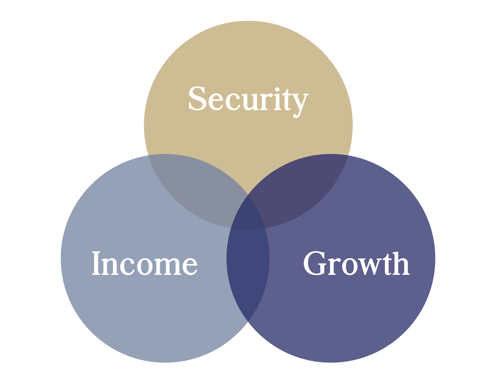
Together, these three primary objectives create a custom mix unique to you. Your investment “color” reflects your financial situation, tolerance for risk, and stage of life.
Our job, as advisors, is to help you understand your needs in each season of your life, build a portfolio that fits those objectives, and adjust the portfolio over time as your circumstances evolve.
In this letter, we’d like to walk you through how we think about this process. We will start with the investment strategies—the primary colors—and then get into how those strategies combine to form your investment color,
the one that meets your specific mix of Security, Income, and Growth.
Primary Colors:
The Investment Models
Colors are central to an artist’s work. The foundation of color science is the primary colors. If they stay constant and reliable, your mixing of those colors will generate an expected result. Without the consistency and integrity of the primary colors, it becomes impossible to reliably combine them to make the color that you need.
We offer several investment strategies at DCM, each built to target different objectives. One of our crucial goals in managing these strategies is to keep them focused on their specific roles.
Rising Dividend™ Cornerstone
Primary focus: Security; Secondary focus: Income; Tertiary: Growth
Our Rising Dividend Cornerstone model seeks to balance each of the three objectives: Security, Income, and Growth.
The foundation of this strategy is Security. We invest in approximately 30-35 high-quality, cash-generating businesses diversified across different industries to reduce risk. Next, we focus on providing income by targeting an above-average dividend yield and dividend growth. Finally, we look for companies where strong business performance is closely reflected in their stock prices. This gives us confidence that as these companies grow, their stock prices are likely to grow as well. Over time, a rising income stream can help support higher stock prices, leading to long-term growth in both income and overall portfolio value.
The foundation of Security never changes, but we will tilt a bit more between Income or Growth, depending on where we see opportunity. We’ve been tilted a bit more towards Growth in the last few years, as artificial intelligence (AI) and technology have become increasingly important themes.
While we do tilt the portfolio, we still strive to maintain balance—never reaching too far in one direction or the other. We’ve participated in the AI theme within the stocks and sectors we felt met our criteria for Security and Income, but we never want to go so far as to compromise the core targets of Security, Income, and Growth. Many of the companies that fit the AI theme don’t fit one or more of those criteria.
Growth stocks have certainly been the focus over the last few years, both in the markets and amongst many of you. For many, the focus has shifted towards building a legacy for the next generation.
Rather than pushing Cornerstone further toward Growth, we built a separate Growth-oriented strategy designed specifically for investors with those objectives.
Sequoia
Primary focus: Growth
In 2021, we introduced Sequoia, which is entirely focused on maximizing total return. We built it as a complement to our other strategies; rather than changing the strategies themselves, each client could allocate a percentage to Sequoia, driving their allocation to Growth.
Sequoia is a concentrated portfolio of 20 stocks. It starts with a universe of 50 high conviction hedge fund holdings. We then apply many of the same quantitative data we use to manage our other strategies to score each stock. Based on those scores, our algorithm selects 20 stocks, each equal-weighted on a quarterly basis.
Just like Cornerstone, we want to remain consistent in our methodology and philosophy. When the market turned away from Growth stocks, as it did in 2022, we kept Sequoia’s focus the same. From 2023 to 2025, the market favored Growth, and Sequoia has done well.
Going forward, there will come a time when Sequoia is out of favor, and the market shifts its preference back towards more Income/Security. When that happens, we won’t panic; it would be a disservice to try to change Sequoia into something it’s not just to chase whatever the market favors from one year to the next.
Income Builder
Primary focus: Income, Security, & Growth (in that order)
While Sequoia is a perfect fit for clients who want to shift more towards Growth, Income Builder is a great fit for clients who need less Growth, but more Income.
Income Builder, like Cornerstone, is a dividend-focused strategy. It, too, focuses on cash-flow positive companies that pay dividends. However, it seeks to maximize Income as much as possible while still maintaining adequate Security.
There are plenty of stocks with dividend yields of 8%+, and we could build a portfolio full of them; however, the risk of dividend cuts is dramatically higher, and we would need to sacrifice diversification. We aim to build a portfolio that produces sustained income over time that grows at least with inflation. At present, Income Builder has a dividend yield of around 4%.
While we do seek dividend growth, the growth rate of companies in Income Builder tends to be lower than Cornerstone. Our goal is to keep up with inflation, grow income with the companies themselves, and replace lower-yielding stocks with higher-yielding ones.
Navigator
Primary focus: Growth; Secondary focus: Security; Tertiary focus: Income
If you’ve never heard of Navigator before, that’s because it’s a new strategy. While it’s new in title, it’s really a refinement of our Core Select strategies, which we’ve managed for many years.
Core Select was built specifically for smaller accounts where buying individual stocks was not feasible; instead, we managed a portfolio of exchange-traded funds (ETFs) to target Security, Income, and Growth objectives.
ETFs are essentially mutual funds that trade on the exchange. The first ETF was launched in 1993. When we first launched Core Select, the ETF landscape was still relatively niche. In 2011, there were 1,200 ETFs with a 10% total market share.
Over the years, we’ve seen this change dramatically. ETFs have become a mainstream investment vehicle, with an increasingly complex landscape of choices. In August 2025, the number of ETFs—then 4,300—surpassed the number of individual stocks—then 4,200.
These ETFs have also evolved from simple index trackers into sophisticated tools that can express specific exposures, like quality, momentum, and value. These were once only accessible through individual stock selection.
Meanwhile, broad market indices like the S&P 500 have become increasingly concentrated. In 2025, only ten stocks represent more than 40% of the Index.2 The Technology sector is now at a 40% weight, surpassing its weight at the peak of the dot-com bubble in the late 1990s/early 2000s. What was once a relatively diversified basket of 500 stocks has become a concentrated bet on a few Growth stocks, many in the Technology sector. This has raised concerns about excessive concentration and potential bubbles.
Navigator is DCM’s response to both. Built on years of ETF research and governed by DCM’s Investment Policy Committee, Navigator is an actively managed strategy that combines three factors—quality, momentum, and value—into a portfolio designed to deliver a more attractive risk/return profile than the broader market.
Navigator is an active approach to passive management. Just like our other strategies, we will take an active approach to the portfolio, positioning it to take advantage when we see opportunity. The only difference is that we will use ETFs to implement our best thinking rather than individual stocks.
Navigator is for those who want broad market participation, actively managed to reduce exposure to concentrated indices.
Your Primary Color
Now, let’s transition away from the investment models—the primary colors, if you will—and start talking about how we can mix these together to make the strategy that best meets your unique combination of Security, Income, and Growth.
To do that, we’d like to go through a few cases. The following are hypothetical examples based on common client situations. They do not represent any specific client; rather, these are situations where objectives for Security, Income, and Growth may have shifted, and an example of where we might shift to different strategies to fit those changes.
- Case #1: Legacy
Many retirees find that, over time, their withdrawal rate changes. They may have initially needed 4% of their portfolios to cover living expenses. Over a few decades, however, that can change significantly.
One reason may be market growth. If your portfolio value were to double in relation to your spending, your need for income generation would be significantly reduced. In those cases, we’ve seen clients move from needing an equal blend of Security, Income, and Growth—which Endowment-Cornerstone targets—towards either more Security or more Growth.
Rather than lean more into Security to preserve what they already built, many have decided they’d rather consider investing more for the next generation. For those in this situation, we’ve shifted non-taxable accounts, especially Roth IRAs, more towards Sequoia. This keeps Endowment-Cornerstone to do the income-generation heavy lifting, while targeting more growth for accounts intended for legacy.
- Case #2: Higher Income Objective
There are other cases where situations cause need for more income. The death of a spouse can mean losing half of a pension and/or Social Security.
Often, shifting towards higher fixed income allocations (our “Preservation of Capital” strategy) and Income Builder strategy can boost income, helping to partially or completely offset the loss in fixed income sources.
- Case #3: High-Tax Accumulators
For an accumulator—someone who is not taking from, but adding to their investment portfolios—Income is of little concern. The primary objective in this phase of life tends to be Growth and maximizing savings by minimizing taxes.
This is where our Navigator strategy would be most appropriate, especially for taxable accounts. Once someone reaches pre-retirement, we would consider shifting their portfolio more towards fixed income and our dividend income strategies—Cornerstone and Income Builder—as they begin replacing their paychecks with dividend income.
Does Your Color Still Fit?
We hope this letter has given you insight into how we think about your objectives and how each portfolio fits those goals.
We want to ensure that we understand where you stand regarding your needs for Security, Income, and Growth. Are you entering a new phase of life? Have you become more accepting of risk over time? More desiring of faster growth? Needing more income?
If any of the above apply to you, we encourage you to share with your DCM Advisor. As your circumstances and priorities evolve, want to be sure your mix of Security, Income, and Growth stays aligned with your ever-changing objectives.
As always, we appreciate your trust in us and take our obligation seriously to help you meet your long-term financial goals, whatever those may be.
1 Throughout this letter, 'Security' refers to one of three investment objectives we use to describe portfolio positioning — it does not mean an account is protected from loss. All strategies discussed involve risk, including loss of principal.
2 The “Great Narrowing”: S&P 500 concentration. RBC Wealth Management. https://www.rbcwealthmanagement.com/en-us/insights/the-great-narrowing-sp-500-concentration
This article, written by Nathan Winklepleck, Director of Investment Strategy & Solutions and member of our Investment Policy Committee, was featured in the Summer 2026 edition of the Rising Dividend Report.
This has been provided for informational purposes only and is not intended as legal or investment advice or a recommendation of any particular security or strategy. The investment strategy and themes discussed herein may be unsuitable for investors depending on their specific investment objectives and financial situation. Information obtained from third-party sources is believed to be reliable though its accuracy is not guaranteed. Opinions expressed in this commentary reflect subjective judgments of the author based on conditions at the time of publication and are subject to change without notice. Past performance is not indicative of future results. An index is an unmanaged portfolio of specific securities, the performance of which is often used as a benchmark in judging the relative performance of certain asset classes. Investors cannot invest directly in an index. An index does not charge management fees or brokerage expenses, and no such fees or expenses were deducted from the performance shown. Neither the firm nor its agents or representatives may give tax or legal advice. You are encouraged to consult with a qualified professional before making any purchasing decisions.
References to “Security,” “Income,” and “Growth” describe relative investment emphases, not outcomes or guarantees. No strategy can ensure a profit or protect against loss.