
"The stock market is a giant distraction from the business of investing."
— Jack Bogle
It’s 1802. Napoleon Bonaparte has just been appointed Consul for Life of France, and the world is bracing for the eventual Napoleonic Wars.
Had you asked any European–or even American–what they thought was the best investment to make in 1802, gold would’ve been a common answer. Few would’ve said to invest in U.S.-based companies.
The headlines would’ve agreed with that sentiment. The U.S. had just elected Thomas Jefferson as its third president, following a contentious term by John Adams. Political infighting amongst the newly freed American colonies is threatening the viability of the new union, which is also drowning in debt. ($81 million!) And that was just the beginning.
In the following year, the Napoleonic Wars began and lasted through 1815. Then the American Civil War from 1861 to 1865. We had two World Wars, the Spanish Flu, the Great Depression, Korean War, Cuban Missile Crisis, Vietnam War, 1973 Oil Crisis, inflation, stagflation, Black Monday (1987), September 11, the Global Financial Crisis (2008), COVID–19, and hundreds, if not thousands, of other negative headlines interspersed between.
Had you known all that ahead of time, would you have put your money in U.S. stocks? Probably not. Despite those headlines, a $1 investment made in the U.S. stock market in 1802, with all dividends reinvested, would have grown to $2,170,948 by 2023.1 And that’s after considering inflation; the nominal value would have been much higher.
What about gold? Considering the nasty headlines from 1802 on, you’d have thought gold would’ve been the best investment you could’ve made. A $1 investment in gold in 1802 grew to $4.18, on an inflation-adjusted basis, by 2023.1
U.S. Treasury Bonds grew $1 to $1,463 and U.S. Treasury bills $237.1
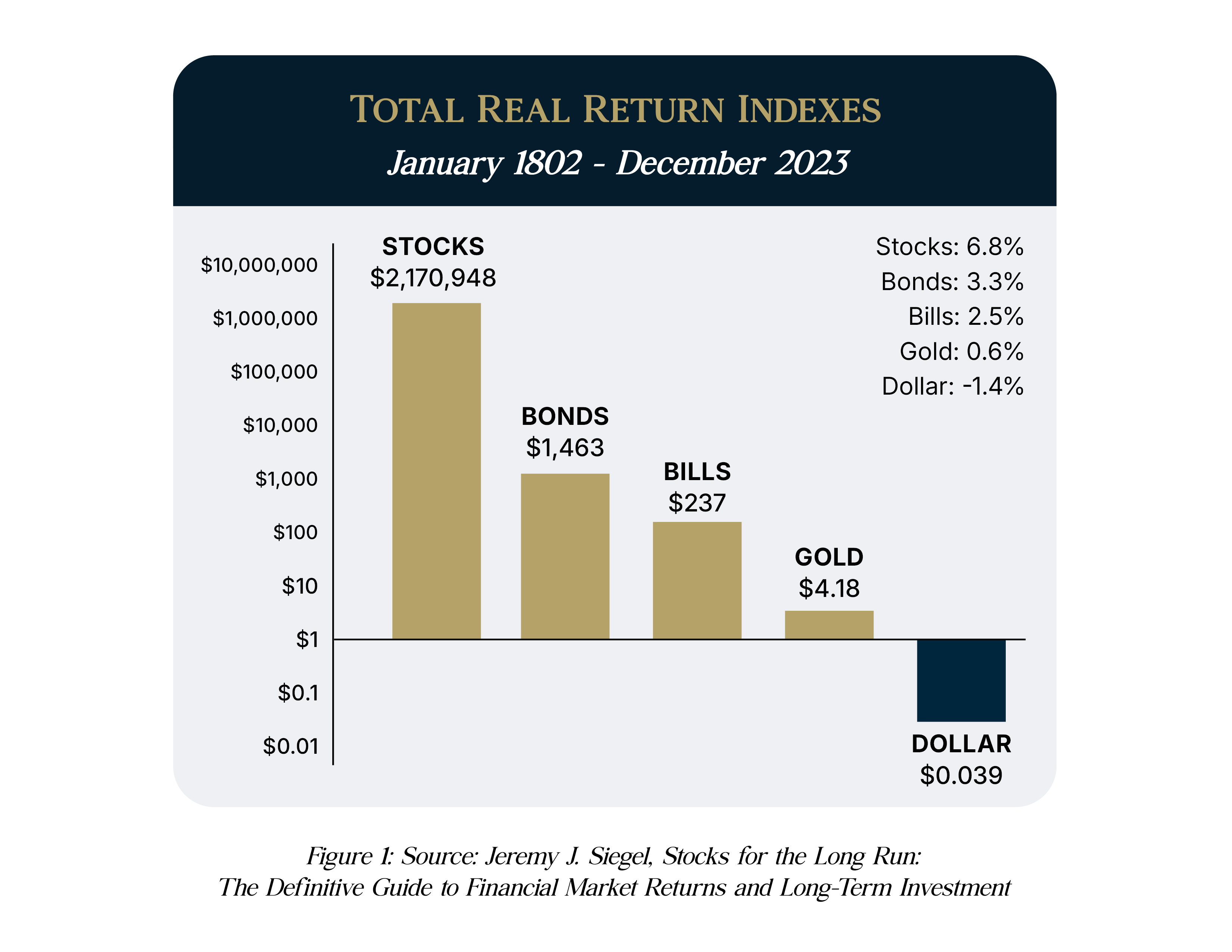
Holding currencies was, and still is, the worst “investment” you could make. $1 in 1802 was worth $0.0392 in 2023.1
Excluding starting a business from scratch or buying concentrated positions in public or private companies, owning a diversified basket of public U.S. businesses has been the single greatest wealth-building engine the world has ever seen.
Are Stocks Really Riskier?
Yes, stocks tend to be more volatile than other assets, but that only is true over short time periods. The risks of stocks decline the longer you hold them. In the preface to his book, Stocks for the Long Run, Jeremy Siegel writes:
[O]ver long periods of time, the returns on equities not only surpassed those on all other financial assets, but were far safer and more predictable than bond returns when inflation
was taken into account.
Gary Antonacci has the data to back that claim up. In his book,
Dual Momentum Investing, he writes:
"For every five-year period since 1807, the worst performance of stocks (–11% per year) was only slightly worse than the worst five-year performance for bills and bonds."
And, when you consider inflation, long-term government bonds can be almost as vulnerable to market shocks as stocks. Antonacci found the maximum drawdown of U.S. government bonds was 68% (inflation-adjusted) compared with 73% for stocks.
Why Stocks Win Over Time
There is a foundational logic to why stocks tend to do well over time. Equities represent ownership in adaptive enterprises. They are dynamic, and have the power to adjust prices, create new products and services where none previously existed, and optimize costs.
Jeremy Siegel notes that stocks have never delivered a negative real return over any 20-year holding period in U.S. history. The worst 20-year real return for stocks was +1.0% annually.
In short, stocks represent an ownership claim on human progress and ingenuity.
Do we get it wrong sometimes? Yes, of course, but the long-term trajectory of human history has been constant progress. From living in caves to living in 2,500 square foot houses built in less than 12 months. From campfires to barbecues. From walking to the neighbor’s house a mile away to visiting Aunt Virginia 1,000 miles away while sitting on heated leather seats. From getting your information from a local newspaper to getting the entirety of human knowledge in a chat format on a sheet of glass that fits in your pocket.
The fundamental belief that underpins a long-term investment in stocks is that the human impulse to innovate and solve problems is a more powerful force than the human impulse for conflict or the cyclical nature of political debate.
Geopolitical Events
Jeremy Siegel notes that stocks have never delivered a negative real return over any 20-year holding period in U.S. history. The worst 20-year real return for stocks was +1.0% annually.
In short, stocks represent an ownership claim on human progress and ingenuity.
Do we get it wrong sometimes? Yes, of course, but the long-term trajectory of human history has been constant progress. From living in caves to living in 2,500 square foot houses built in less than 12 months. From campfires to barbecues. From walking to the neighbor’s house a mile away to visiting Aunt Virginia 1,000 miles away while sitting on heated leather seats. From getting your information from a local newspaper to getting the entirety of human knowledge in a chat format on a sheet of glass that fits in your pocket.
The fundamental belief that underpins a long-term investment in stocks is that the human impulse to innovate and solve problems is a more powerful force than the human impulse for conflict or the cyclical nature of political debate.
Geopolitical Events
Speaking of human impulse for conflict, the U.S. and Israel launched surprise airstrikes on Iran on February 28, 2026, killing Supreme Leader Ali Khamenei. Initial hopes for a short conflict have given way to the expectation that this could last a while.
As much as it feels like war leads to market collapse, that is rarely the case. Research shows that stocks largely take these events in stride, with the general stock market declining less than 5% on average through major geopolitical events going back to Pearl Harbor in 1941.2
Markets do not respond to the existence of conflict, but to whether that conflict changes the amount of earnings companies are expected to earn. If an event does not materially change global GDP growth or earnings trajectory, then the markets don’t pay much attention.
Further, it’s important to remember that there are some companies that benefit from geopolitical conflicts. That’s part of the reason we maintain exposures to different sectors.
Barring a significant disruption in oil for months on end, the Iranian war is unlikely to have a material impact on earnings. If oil prices stay above $100+ for six months, that could change. However, the Trump administration is unlikely to risk driving the U.S. economy into recession ahead of the midterm elections.
Elections & Market Volatility
As much as it feels like war leads to market collapse, that is rarely the case. Research shows that stocks largely take these events in stride, with the general stock market declining less than 5% on average through major geopolitical events going back to Pearl Harbor in 1941.2
Markets do not respond to the existence of conflict, but to whether that conflict changes the amount of earnings companies are expected to earn. If an event does not materially change global GDP growth or earnings trajectory, then the markets don’t pay much attention.
Further, it’s important to remember that there are some companies that benefit from geopolitical conflicts. That’s part of the reason we maintain exposures to different sectors.
Barring a significant disruption in oil for months on end, the Iranian war is unlikely to have a material impact on earnings. If oil prices stay above $100+ for six months, that could change. However, the Trump administration is unlikely to risk driving the U.S. economy into recession ahead of the midterm elections.
Elections & Market Volatility
Speaking of midterm elections, the U.S. midterm elections are coming up in November 2026.
What impact will that have on markets? Research covering 31 midterm elections over 125 years shows a consistent pattern of performance.3
In the 12 months preceding mid-term elections, the S&P 500 averages a return of just 2.9%. This is significantly lower than the long-run norm of 8.9%.3
With the double whammy of both geopolitical and political headlines, we would not be surprised to see stocks enter a correction at some point in Q2. That’s normal; corrections happen about once a year, on average.
What impact will that have on markets? Research covering 31 midterm elections over 125 years shows a consistent pattern of performance.3
In the 12 months preceding mid-term elections, the S&P 500 averages a return of just 2.9%. This is significantly lower than the long-run norm of 8.9%.3
With the double whammy of both geopolitical and political headlines, we would not be surprised to see stocks enter a correction at some point in Q2. That’s normal; corrections happen about once a year, on average.
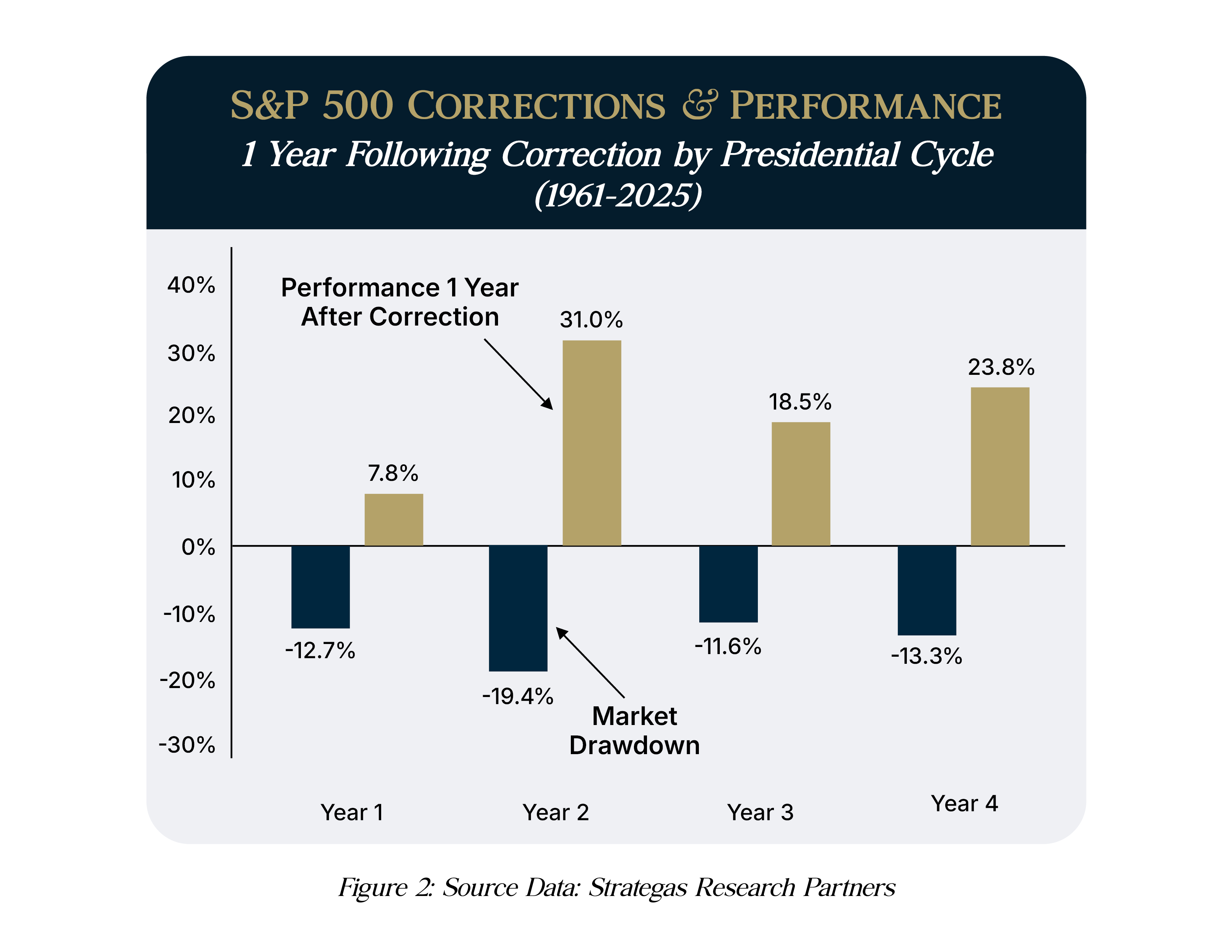
The first half of a midterm election year has historically been the weakest of the presidential cycle. Going back to 1961, the average midterm election year saw a 19.4% top-to-bottom decline.4 However, this could give way to a potential buying opportunity. We have been looking at some companies that we believe would be great fits for our portfolios and may give us a great entry point.
And from a bigger picture perspective, this could be a good opportunity to revisit your asset and strategy allocations. If you have been considering adding exposure to Sequoia or taking a more aggressive tilt to your asset allocation, Q2 2026 heading into Q3 2026 could present a great chance to do that.
Historically, the midterm election-year lull in the first half of the year tends to give way to a relief rally starting in the second half. From the midterm election lows, the average return over the next 12 months has been +31%.4 That is historically the strongest period of the four-year presidential cycle.
But, what if [insert your least favorite party here] wins?
It’s not about which party wins; it’s about the removal of uncertainty.
While war, inflation, recessions, and political upheaval temporarily shake markets, not even the worst of what our world has to offer has broken the underlying engine of progress. Short-term market volatility has always given way to higher stock market prices. We don’t think this time will be any different.
As always, we are here to answer any questions, comments, or concerns you may have. Reach out to us anytime
1. Siegel, Jeremy J. Stocks for the Long Run. 6th ed. McGraw Hill, 2022. Data updated through 2023.
2. LPL Financial: “Iran Escalation: How Markets Have Reacted to Geopolitical Events.”
March 4, 2026. https://www.lpl.com/research/blog/iran-escalation-how-markets-have-reacted-to-geopolitical-events.html
3. U.S. Bank Wealth Management. “How midterm elections affect the stock market.”
January 23, 2026. https://www.usbank.com/investing/financial-perspectives/market-news/stock-market-performance-after-midterm-elections.html
4. Strategas Research Partners. “S&P 500 Corrections & Performance.” 2026.
This article, written by Nathan Winklepleck, Portfolio Manager & Analyst and member of our Investment Policy Committee, was featured in the Spring 2026 edition of the Rising Dividend Report.
This has been provided for informational purposes only and is not intended as legal or investment advice or a recommendation of any particular security or strategy. The investment strategy and themes discussed herein may be unsuitable for investors depending on their specific investment objectives and financial situation. Information obtained from third-party sources is believed to be reliable though its accuracy is not guaranteed. Opinions expressed in this commentary reflect subjective judgments of the author based on conditions at the time of publication and are subject to change without notice. Past performance is not indicative of future results.
An index is an unmanaged portfolio of specific securities, the performance of which is often used as a benchmark in judging the relative performance of certain asset classes. Investors cannot invest directly in an index. An index does not charge management fees or brokerage expenses, and no such fees or expenses were deducted from the performance shown.