
D-I-Why?
I’ve worked in the world of investments and financial planning for nearly thirty years. One day, I might help a family deal with the death of a loved one; another day, I might work on a retirement plan for a business or review investment options for a client; and some days, I study changes in tax rules. So much of my practice is focused on long-term outcomes that I occasionally wonder just how much I’ve actually accomplished in a given day. I guess that’s why I enjoy doing simple household repairs: I get immediate gratification.
Over the years, I’ve learned to paint walls and trim, do minor electrical and plumbing projects, and take mechanical things apart and put them back together. I’m a DIY kind of guy, and I know I’ve accomplished something when the drain is caulked or the lamp works again. However, for serious electrical work, anything related to natural gas, and any chore that involves a ladder, I turn to a pro. I’m happy to pay someone who’s an expert in the field to ensure my safety or to complete a project I’m uncomfortable undertaking.
My professional world is full of amateur “experts.” There are DIY planning and investment resources on every platform imaginable. To get an estimate of how many, I turned to my trusty research assistant, Microsoft’s Copilot AI, and here’s what it found: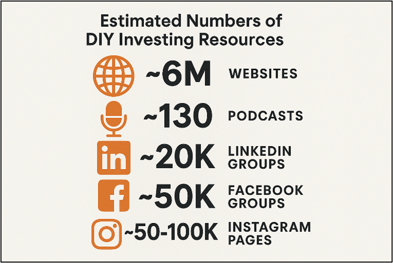 For simplicity’s sake, let’s just say there are about six million places where someone might get DIY assistance, but here’s a question—why? How likely is it that all these sources provide the same information and/or advice? Assuming that’s a low probability, which source is right? Or, more importantly, which one is right for you and your own unique situation? Some are bound to be scams of some sort, but certainly many are maintained by well-meaning individuals. But why take a chance? Why not turn to a professional?
The most common answer I hear is cost. Working with a Registered Investment Advisor like Donaldson Capital Management involves fees for the services rendered. How can someone determine whether the assistance is worth paying for? What do they receive in return?
A couple of years ago, Vanguard attempted to put a value on professional advice by tracking clients who utilized its proprietary ”Advisor Alpha” offering. The results suggest that using a pro could provide an annual return about 2% greater than a DIY approach. Breaking that down a bit, the most valuable services were described as:
- behavioral coaching;
- choosing the most appropriate type of investment account(s) for each client’s situation;
- offering a strategic approach to withdrawing funds from investment accounts.
My most recent newsletter discussed the potential usefulness of fundamental and technical stock analysis. If you chose DCM for investment help, which would we utilize? Actually, our process starts a few steps earlier. Prior to analysis, we consider security of principal, income to minimize volatility risk, and growth to try to reduce the effects of inflation. From there, we thoroughly research the individual stocks, bonds, and occasional ETFs that we purchase for our clients. The basis for our investment decisions is fundamental analysis, but we turn to technical analysis to help with the timing of buy and sell decisions.
It is not DCM’s intention to “beat the market.” It is our intention to help our clients achieve their goals by suggesting tax-wise strategies, providing counsel and advice specifically tailored to their unique situations, and doing all of this at a reasonable price. Across the roughly 1,800 households we serve, our advisory fees average around one percent. There are almost never charges for buying or selling securities, and when we report performance, it is always our clients’ total return after all expenses (market appreciation + income – fees and expenses).
Because there is more than one type of investor, DCM offers investment strategies oriented towards maximum growth, sustainably increasing income, and preservation of capital. We sometimes blend approaches to meet specific needs. Regardless of which approach is suggested, our security, income, and growth overlay will always govern the selection of individual securities. We are long-term investors and do not engage in speculative buying and selling, the use of derivative securities, or so-called alternative assets.
Under what circumstances should a DIY investor consult a paid advisor? I think that anytime someone is unsure of the next step, seeking advice might be indicated. In the case of DCM, there is never a charge for an initial visit. That meeting might result in quick answers to specific questions, or it might result in a thoughtful offer of services. Regardless, it will always be advice given in the best interest of the potential client.
Warren Ward, CFP®
Senior Investment Advisor
To learn more about Warren or read his previous articles, visit his profile page here.
This was prepared by Donaldson Capital Management, a federally registered investment adviser under the Investment Advisers Act of 1940. Registration as an investment adviser does not imply a certain level of skill or training. The oral and written communications of an adviser provide you with information about which you determine to hire or retain an adviser. Donaldson Capital Management, Form ADV Part 2A & 2B can be obtained by visiting https://adviserinfo.sec.gov and searching for our firm name. Neither the information nor any opinion expressed is to be construed as solicitation to buy or sell a security of personalized investment, tax, or legal advice.
This has been provided for informational purposes only and is not intended as legal or investment advice or a recommendation of any particular security or strategy. The investment strategy and themes discussed herein may be unsuitable for investors depending on their specific investment objectives and financial situation. Information obtained from third-party sources is believed to be reliable through its accuracy is not guaranteed. Opinions expressed in this commentary reflect subjective judgments of the author based on conditions at the time of publication and are subject to change without notice. Past performance is not indicative of future results.
Certified Financial Planner Board of Standards Center for Financial Planning, Inc. owns and licenses the certification marks CFP® and CERTIFIED FINANCIAL PLANNER® in the United States to Certified Financial Planner Board of Standards, Inc., which authorizes individuals who successfully complete the organization’s initial and ongoing certification requirements to use the certification marks.