
It’s a tradition for our Winter newsletter to feature Mrs. Q, a hypothetical client. In this conversation, we focus on many of the same questions we’ve gotten from you as we review 2025 and look ahead to 2026.
Mrs. Q: What changes did you see in the economy because of tariffs?
DCM: In April 2025, the United States dramatically escalated tariffs under what the administration dubbed “Liberation Day.” President Trump imposed a blanket 10% tariff on all U.S. imports and country-specific rates up to 50% on dozens of trading partners. Imports from China were hit with effective tariffs of 145%.
These sweeping measures were the most drastic since the 1930 Smoot-Hawley Act. The uncertainty sent the S&P 500 down nearly 20% in under two months. Corporate bonds also declined in price.
The sharp stock and bond market reaction forced the administration to recalibrate, both delaying and lowering the effective rate of the tariffs. Since then, the tax provisions in the One Big Beautiful Bill Act (OBBBA) have aimed to further reduce any negative impact from tariffs.
Mrs. Q: I’ve read a lot about the S&P 500 this year and how it has been driven by only a few stocks. Why is that?
DCM: The S&P 500 is heavily impacted by just a handful of stocks because it is market capitalization weighted. A company’s “market cap” is the total value of the company, so total shares outstanding multiplied by price.
So, the most valuable companies get the largest weight. And as a stock’s price goes up, so does its market cap.
Nvidia, for example, is the largest weight in the S&P 500 at 8.5%. Apple is the next highest at 6.8%, then Microsoft at 6.6%, and so on.1
In total, the biggest 10 companies in the S&P 500 make up roughly 40% of the index. The other 490 stocks make up
the other 60%.
Mrs. Q: So, if one of those stocks goes up in price, the index buys more?
DCM: Yes, that’s right.
Mrs. Q: Doesn’t that result in stock bubbles?
DCM: In a way, yes. If a stock or group of stocks gets dramatically overvalued, new assets into the index funds that track that index will continue to buy them at a higher weight.
Mrs. Q: Is my portfolio weighted like that?
DCM: No, your portfolio is most similar to an equal-weighted portfolio. For example, if your portfolio is invested in our Cornerstone™ model, it typically has between 30 to 35 stocks, so a full position would be roughly 3% in one stock.
At times, we do allow a stock to drift higher in value. In some cases, the stock could reach as high as 5% or more before we would trim it back. That all depends on your specific tax situation and overall portfolio.
Mrs. Q: Is there an equal-weighted version of the S&P 500?
DCM: Yes, an equal-weighted version of the S&P 500 is when all stocks are purchased at a 0.2% weight each and then rebalance back to 0.2% periodically.
In 2025, the equal-weighted S&P 500 was up 11.2% compared with the S&P 500 market-cap weighted index up 17.9%.
If we look for the cumulative 3-year period, the equal-weighted version of the S&P 500 was up 42.5% compared with 86.01% for the market-cap weight.
Mrs. Q: Shouldn’t we just switch to a market cap weighting scheme?
DCM: If the past few years were any indication, that would make sense. However, longer-term history would favor an equal-weight methodology.
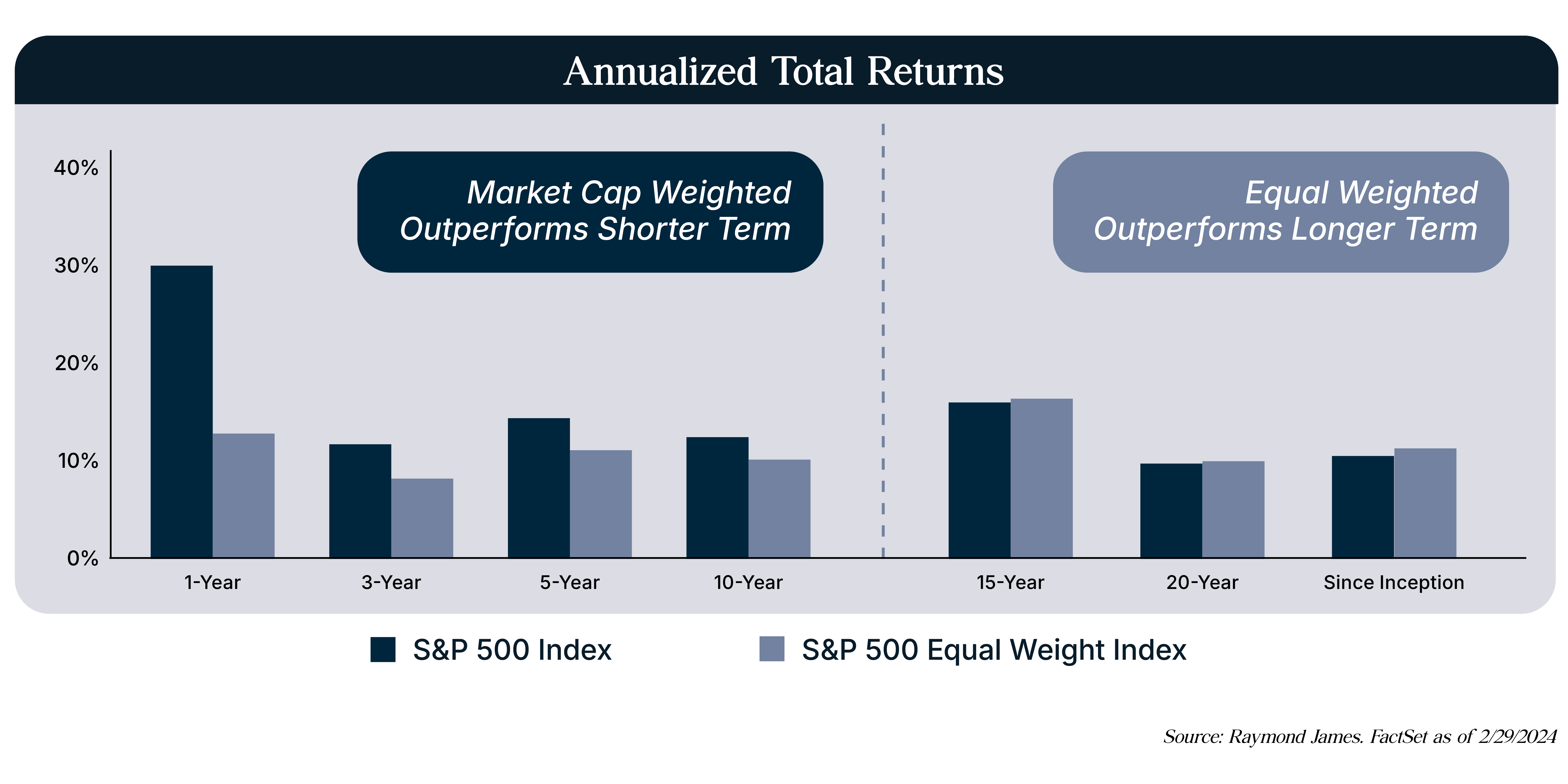
Raymond James did a study comparing equal-weight to market-weight. They found that, in the short term, market-cap weighting has been the best. Longer term, however, tends to favor equal-weight methodologies, as seen in the chart below.
Mrs. Q: Do you think 2026’s midterm elections will have a big impact on stock prices?
DCM: Midterm election years have historically been weaker than average. Since 1932, midterm election years have generated 5.8% per year price returns (not including dividends); that’s the weakest of all years in the presidential cycle.2
In the 12 months leading up to the midterm election, which we’re already in, stocks have been roughly flat (0.3%) compared with the historical average return of 8.1%.
We’ve also historically seen corrections in the year leading up to a recession.
We have seen an average top-to-bottom decline of 20.6% at some point prior to the election. Even with that volatility, which we could very well see in 2026, stocks have generated positive returns in those midterm years.
Much of that has to do with the relief rally after the midterm election year lows. From 1934-2019, the average gain from low to high was 46.9% post midterm-year.
After the midterm elections, the market typically gains clarity and rallies into the third year of the presidential cycle, which has historically been the best year for stock markets—averaging 16.3% price-only returns since 1932.
So, history would suggest that midterm election headlines and the political uncertainty they cause may weigh on stocks in 2026, especially in the first half, but then give way to a relief rally as results become clearer toward the end of 2026 and into 2027.
Mrs. Q: If you think we will get a pullback, does that mean we should do something?
DCM: As tempting as it is to try to time the market, doing that has rarely paid off. However, we would suggest a few things heading into 2026, or any year for that matter:
- Have an emergency fund.
While everyone’s situation is different, we typically suggest setting aside a few months’ worth of expenses in cash. This way, if a large, unexpected expense arises, you won’t need to sell stocks at a lower price to cover it. - Prepare yourself mentally.
Remember, market volatility is a normal and healthy part of investing. If stocks went up 10% every single year with no downside, everyone would invest in them and drive the prices up to the point where they wouldn’t return that much. In effect, stocks pay you for tolerating the volatility. - Stick with your plan.
Since you’re living on the interest and dividends from your portfolio, there’s no need to panic if market prices fall. It’s better to be disciplined, not getting excited when prices rise or scared when prices fall. Remember, your financial plan projections included assumed market corrections throughout your retirement. We account for those as an unfortunate, but necessary, and normal part of everyone’s retirement. - Prepare to take advantage of it.
If we get a correction, that almost always presents an opportunity. If you’ve been looking to get more aggressive, either in strategy or asset allocation, a correction is a great time to do that. It’s also a good time to consider Roth conversions or other tax-efficient transfer strategies.
Mrs. Q: Last question, do you think the Federal Reserve is likely to continue cutting interest rates in 2026? And what impact will that have on stocks?
DCM: Remember that the Federal Reserve has a two-part mandate: stable prices and low unemployment. With inflation appearing contained, the Fed’s attention is towards some weakness developing in the labor market. That puts them on more of a path of monetary stimulus, which means continuing to lower the Federal Funds rate in 2026.
How the Fed progresses in 2026 will be data dependent, of course. We’ve seen expectations about what will happen to monetary policy, even from the Fed itself, shifting rapidly. But, to start the year, the Fed seems to be viewing employment as the biggest risk. President Trump has also been outspoken about a new Fed chair who he would like to see lower interest rates. Regardless of how they get there, lower interest rates should continue to be supportive of the stock market, reducing some of the elevated political risks.
Mrs. Q: Can you summarize your views on 2026?
DCM: Just to wrap up our conversation, we expect 2026 could be a year of elevated volatility from uncertainty about midterm elections. It wouldn’t be a surprise if we had a correction, or were close to it, at some point. Historically, stocks have had a 10%+ pullback every single year, 15% every other year, and 20% every 3 to 4 years.3
Offsetting the uncertainty from midterm elections will be lower interest rates and tax breaks from the OBBBA, which should both support the economy and markets. Earnings expectations are strong, which also tends to boost stocks.
We also expect the artificial intelligence (AI) trade to soften, something we started to notice toward the end of 2025. AI spending is already significant, and expectations are high. Much of that optimism is being baked in, so we would expect a valuation-driven slowdown at some point. Ideally, the market expands from just the “S&P 10” into the “S&P 490”—where the benefits of AI start to trickle into the real economy and positively impact all businesses, not just a few.
Mrs. Q: Do you have any final thoughts for me?
DCM: As we enter a new year, it’s a good time to reflect and re-evaluate. We would encourage you to take another look at your entire financial picture, from beneficiaries and insurance, to any major spending needs or account windfalls. If there’s anything major, we can re-work your financial plan and tweak your portfolio, if necessary, to prepare.
Mrs. Q: I’ll do that. Thank you, and I look forward to our conversation again next year!
1. Source: Vanguard S&P 500 ETF (VOO). Morningstar, December 9, 2025.
2. “Equities and the Election Effect.” 2022. RBC Wealth Management—Asia. September 8, 2022.
3. “How Frequent Are Market Corrections of Various Sizes?” Sound Mind Investing. 2024. https://soundmindinvesting.com/articles/how-frequent-are-market-corrections-of-various-sizes.
This article, written by Nathan Winklepleck, Portfolio Manager & Analyst and member of our Investment Policy Committee, was featured in the Winter 2026 edition of the Rising Dividend Report.
This has been provided for informational purposes only and is not intended as legal or investment advice or a recommendation of any particular security or strategy. The investment strategy and themes discussed herein may be unsuitable for investors depending on their specific investment objectives and financial situation. Information obtained from third-party sources is believed to be reliable though its accuracy is not guaranteed. Opinions expressed in this commentary reflect subjective judgments of the author based on conditions at the time of publication and are subject to change without notice. Past performance is not indicative of future results.
An index is an unmanaged portfolio of specific securities, the performance of which is often used as a benchmark in judging the relative performance of certain asset classes. Investors cannot invest directly in an index. An index does not charge management fees or brokerage expenses, and no such fees or expenses were deducted from the performance shown.

.png?width=900&name=careers%20(3).png)
